An exhibition essay · Anthony J. Evans · 2005

Common Moments in 20th Century Art & Economics

Cubism. Futurism. Neoplasticism. Positivism. Creative destruction.

The disciplines of art and economics are not natural bedfellows. To many, artworks are seen as predominantly aesthetic expressions, where judgement is subjective. By contrast economics is a social science and journal articles can be compared objectively. This article attempts a more genuine arbitrage, and brings the concepts of "a painting" and "an article" closer together than is usually assumed.

Enter the exhibition →
"Art, I think, is the producing, by means which are subject to explicit constraints, effects in the recipient's thought and feeling. General Equilibrium is an art form in this sense." — G.L.S. Shackle, in a letter to Brian Loasby, 24 April 1975
Room I

Engulfment: Cubism, Futurism & Positivist Economics

Picasso & Friedman

Fusing Art & Economics

A painting is more objective than the layman believes: it can be judged, and interpreted. All works are not equal. Behind every picture lies a theory, and such theories can blend, mutate and diffuse in art as in any discipline.

Economics articles are more subjective than the pretensions of hard science might claim: some are more enjoyable to read than others, and all depend upon a methodological foundation that shifts over time. A modernist piece of economics is, in many ways, closer to modernist art than it is to classical economics.

Another factor that binds art to economics is the underlying cultural climate — perhaps the key causal variable in the analysis that follows.

The Stream Toward Abstraction

In the increasingly conceptual path of 20th century painting, cubism was a critical junction. Alfred Barr wrote that the art and theories of Cezanne and Seurat "passes through the widening stream of cubism and finds its delta in the various geometrical and constructivist movements."

We can imagine a stream of economic methodology that also leads toward increasing abstraction, but where the critical junction was a Positivist engulfment. The twin contributions of Picasso and Friedman demonstrate an engulfment that paved the way for high modernism.

"Moments" are a postmodern method of deconstruction. All action occurs within broad movements of thought, but such movements are the conscious creation of individuals — leading to a comparison of individual works, within the apparatus of movements.

01
Picasso, Les Demoiselles d'Avignon, 1907
Pablo Picasso — Les Demoiselles d'Avignon (1907) Oil on canvas, 243.9 × 233.7 cm · Museum of Modern Art, New York
The Spark

Where Cubism Begins

The spark that lit the cubist movement is unmistakable within Les Demoiselles d'Avignon. It was painted by Picasso in 1906–07 and the fusion of traditional Negro sculpture with fragmented natural form responded to the call of Cezanne, the father of modern painting: "you must see in nature the cylinder, the sphere, the cone."

Whereas pure abstraction is the arrangement of abstract geometric elements, near abstraction is an approach toward this, where natural forms retain presence. In Picasso's Violin the title itself reminds the viewer that we are looking at a representation of reality. However the innovation of style — seen in the angular form and a restrained palette — switches our focus from the object under study, to the methods used in capturing it.

This switch was also triggered by the parallel engulfment in economics. Just as Picasso bridged Cezanne with abstraction, Friedman provided the critical engulfment that created the dominance of logical positivism as the standard of economic theory.

The Futurist Interruption

As an example of "cubist engulfment" consider the Futurist movement. Its legacy became entangled with the Fascism it supported, but the political connotations and aspirations of the Futurists should not preclude genuine study of their art. In 1909 F.T. Marinetti wrote "The Founding and Manifesto of Futurism", passionately defending the industrialization of the period. Practiced by artists such as Umberto Boccioni and Medardo Rosso, the Futurist blast provided two crucial points of departure from cubism: methods of composition, and self-reference.

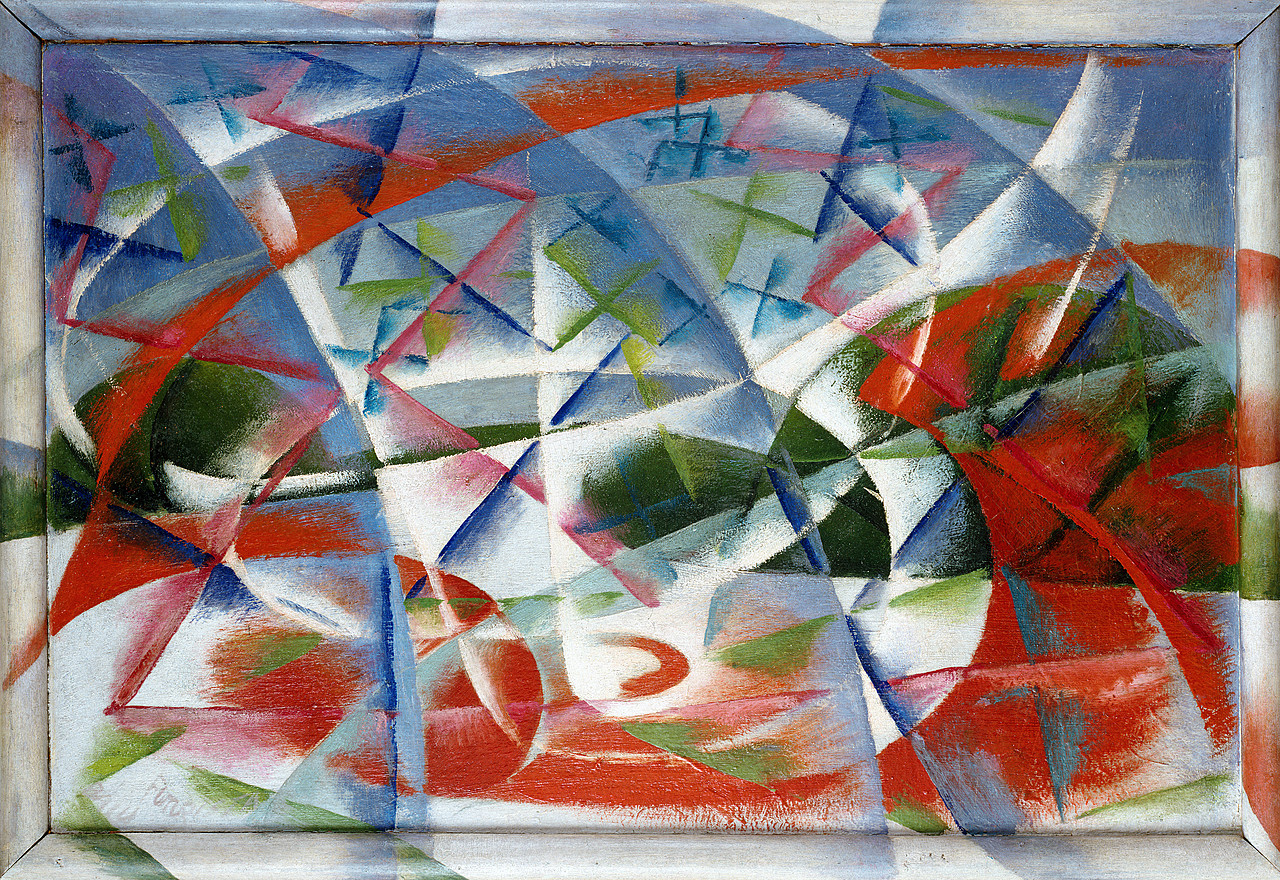
Regarding composition, a crucial construct of Futurist art was "movement, force and the passage of time", and their techniques to capture this are distinctive. A further alignment between futurism and vorticism is their attitudes toward their peers. Vorticism reacted to the irrelevancy of the Bloomsbury elite, whilst the futurists treated the academe with complete contempt.

The world's magnificence has been enriched by a new beauty: the beauty of speed. A racing car whose hood is adorned with great pipes, like serpents of explosive breath — a roaring car that seems to ride on grapeshot is more beautiful than the Victory of Samothrace. — F.T. Marinetti, The Founding and Manifesto of Futurism, 1909
03
Balla, Speed Car, 1913
Giacomo Balla — Speed Car (1913) Different lines of force: expanding arcs and acute chevrons. A compenetration of planes where the object has been fused to its surroundings to create instability.
04
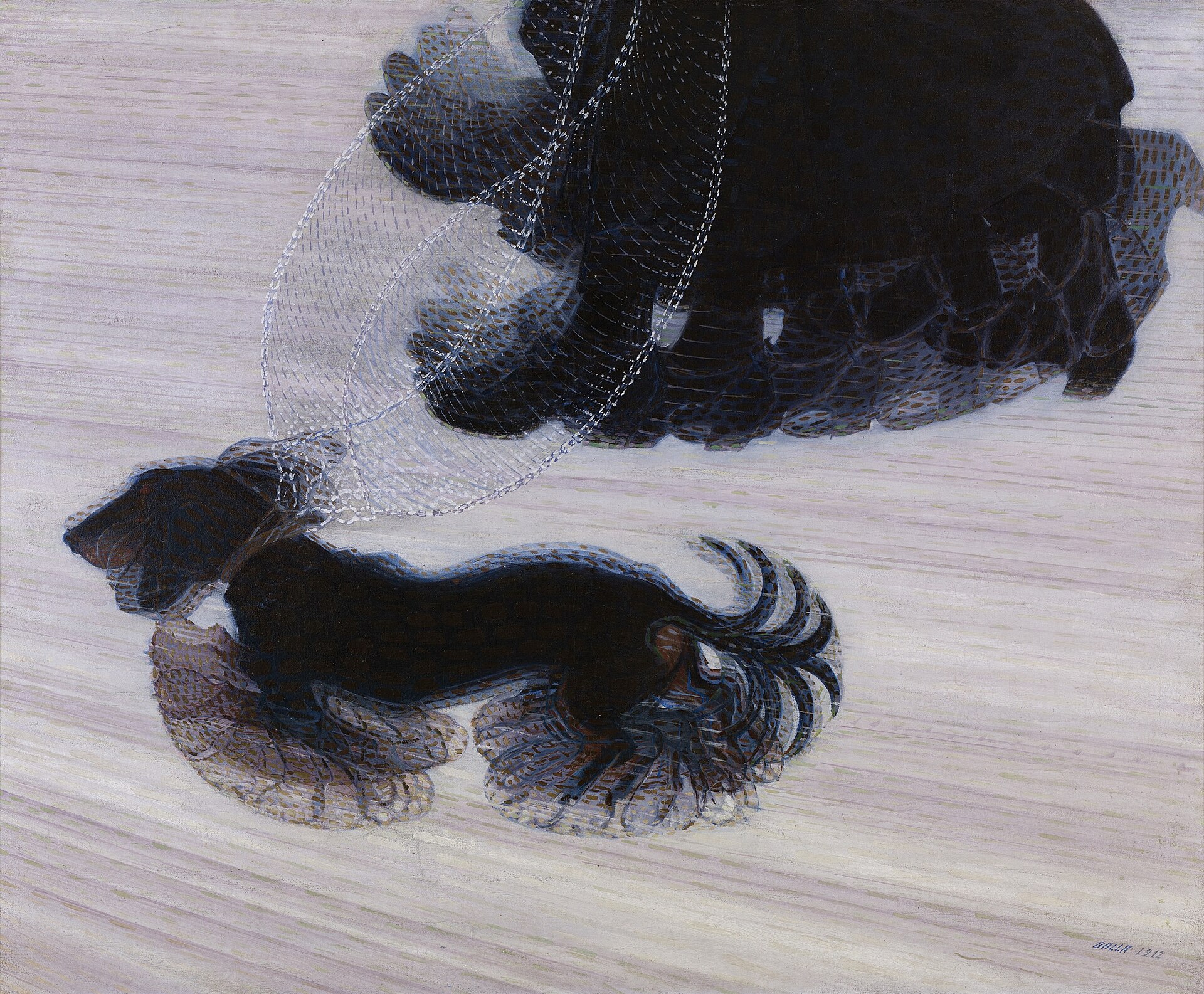
Balla, Dog on a Leash, 1912
Giacomo Balla — Dog on a Leash (1912) Kinetic simultaneity: the dog's feet appear to be a blend of multiple frames. The new value placed in the transitory, the elusive, and the ephemeral.

Futurism & Schumpeter

Contrast the futurist vision with the economics of Joseph Schumpeter. The Austrian's economics is driven by spurts of innovation — technological shifts — that destroy established businesses and creates new ones. A capitalist economy is portrayed as essentially dynamic, and therefore a process of economic change is imperative to capture within theory.

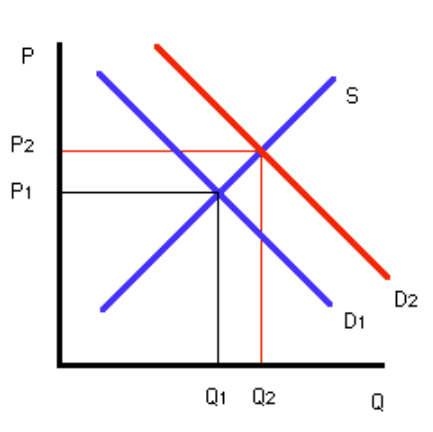
Indeed the dust jacket of Schumpeter's classic Capitalism, Socialism and Democracy uses the Futurist technique of simultaneity. The second direct relevance of Futurism for economic methodology concerns the capturing of time. In the simple supply/demand graph, when an exogenous force affects demand we depict it by shifting the curve: an instantaneous leap from one equilibrium point to another. Futurism illustrates an endogenous dynamism missing from most art, and most economics.

The Cubist Engulfment

Whereas cubist art became increasingly intellectual, the futurists engaged. As a productive movement it had died out by the 1920s since their thirst for war proved incompatible with a sustainable association. The demise was also due to an engulfment by cubist style.

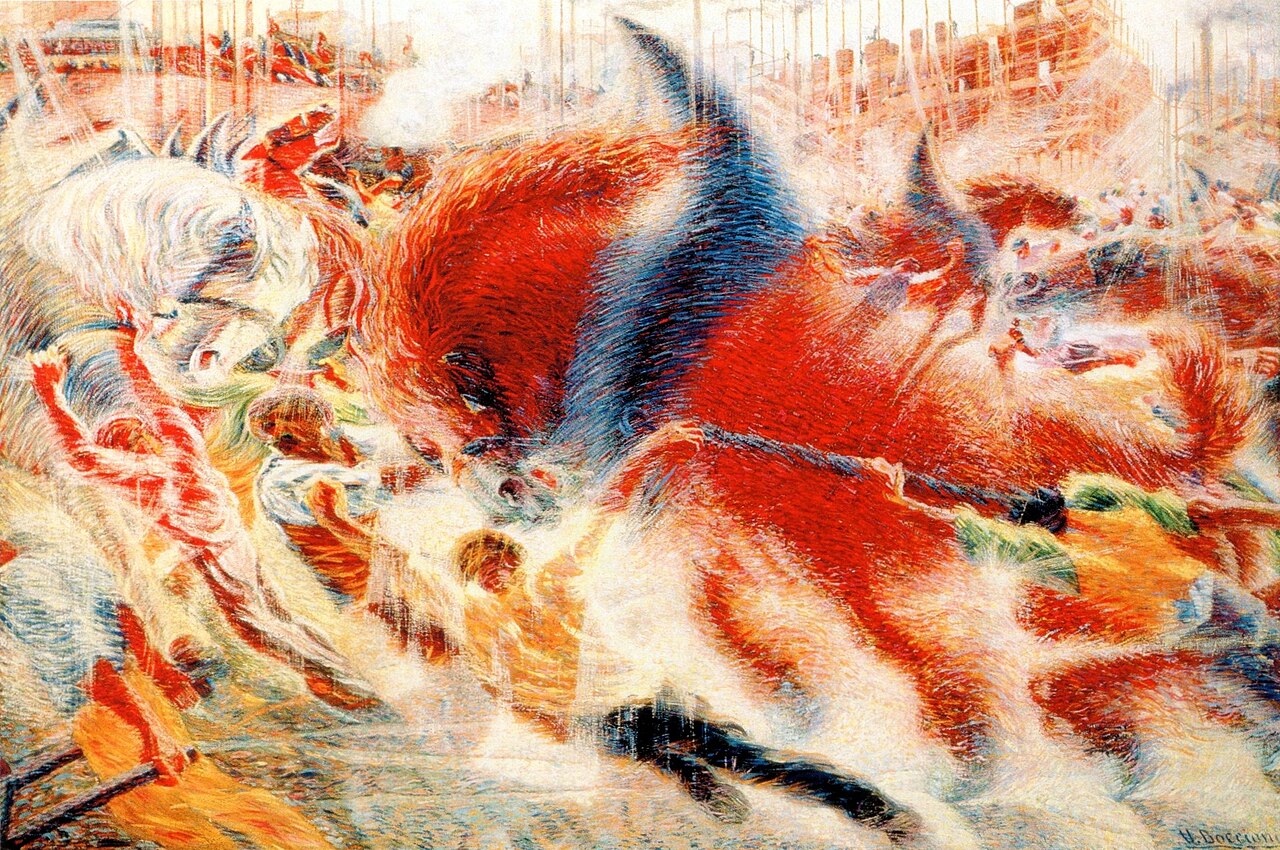
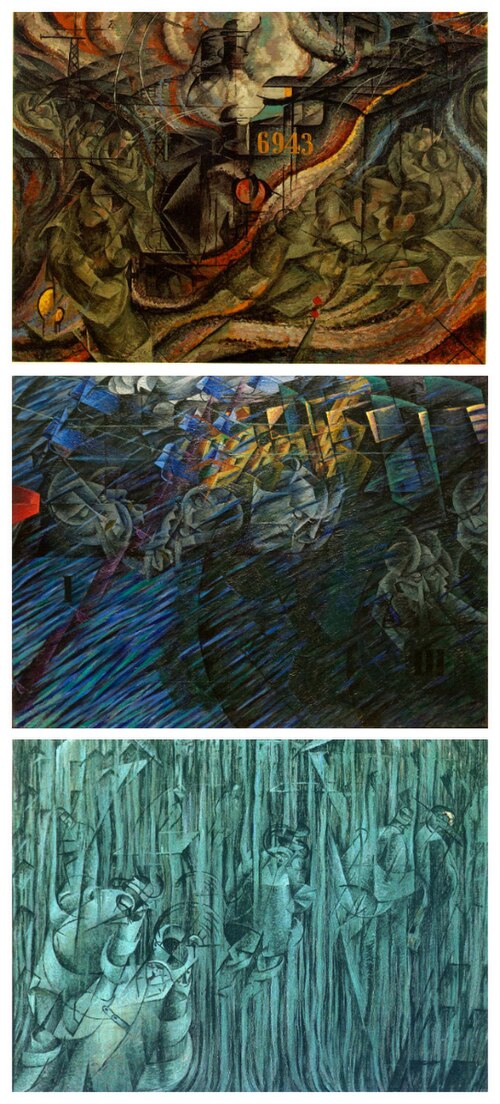
Comparing two Boccioni paintings best sees the cubist influence on futurism. In The City Rises we see an immense equine perfectly encapsulate the power of progress to both enthral and scare. It was painted in 1910, the year that Boccioni visited Paris and became exposed to cubism. Upon his return he painted State of Minds, and the engulfment is striking.
08
Boccioni, The City Rises, 1910
Umberto Boccioni — The City Rises (1910) Painted before Boccioni's Paris visit. An immense equine perfectly encapsulates the power of progress to both enthral and scare.
09
Boccioni, State of Minds, 1911
Umberto Boccioni — State of Minds (1911) Painted after Boccioni returned from Paris, having been exposed to cubism. The engulfment is striking.
Cubism — Alfred Barr, 1936

Picasso on Resemblance

Since resemblance to nature is at best superfluous, and at worst distracting it might well be eliminated.

Barr, Cubism and Abstract Art, MoMA New York, p.13

Positivism — Bruce Caldwell, 1994

Friedman on Realism

Friedman warns that attempts to make assumptions more 'realistic' are not only unnecessary but methodologically unsound — simplicity, not realism, is a methodological virtue; realism in assumptions is a methodological vice.

Caldwell, Beyond Positivism, p.66

A preoccupation with testability in economics, and an increasing sophistication of technique in art were the driving forces behind modernist abstraction. Cubism was a methodological position that shaped the future theoretical trajectory of modern art. To the futurists the subject matter was important: the machine came before the abstract force. Cubism showed less interest as they developed near abstraction, and the increasing victory of technical sophistication over content.

The peculiarities of human conduct consequently took a back seat to the rational agent with full information. What had previously been the object of study became irrelevant to the methods of composition: the technique of positivism. Models are the apparatus of discovery, where simplicity and predictability are preferred to realism.
Room II

Entrepreneurship & Equilibrium

Schumpeter & Futurism versus Kirzner & Mondrian

The Artist as Entrepreneur

We can bring the artist into the fray, and liken them to entrepreneurs. Amidst uncertainty, they must speculate as to reception their work will receive, and whilst an artist's aspiration might well be prestige rather than pecuniary income they will still create for an impact. They try to predict, they assemble, they create. The idea that commerce and culture are at odds is a modern conception.

If artists are entrepreneurs, then there's enough deviation in the entrepreneurship literature to justify a brief review before drawing the parallel further.

Two Theories of Entrepreneurship

In Theory of Economic Development, Joseph Schumpeter defines entrepreneurship as new combinations — "the different employment of the economic system's existing supplies of productive means." These types of innovation are the catalyst of a dynamic economy. The entrepreneur takes an existing stock — equilibrium — and disrupts it.

The common contrast is the work of Israel Kirzner. In Competition and Entrepreneurship he resurrected an alternative notion whereby entrepreneurs move an economy toward equilibrium. Kirzner added to Cantillon the notion of alertness — a costless discovery mechanism for unique information, or undiscovered opportunity.

Futurism · Schumpeter

Creative Destruction

"Capitalism, then, is by nature a form or method of economic change and not only never is but never can be stationary… It must be seen in its role in the perennial gale of creative destruction; it cannot be understood irrespective of it." — Schumpeter, 1942

Neoplasticism · Kirzner

Alertness & Arbitrage

Kirzner's entrepreneur is a progression from Mises, who saw the entrepreneur as someone who could correctly anticipate the future wants and needs of the market. The function of the entrepreneur is to use the profit motive as a guide to move resources to their highest value — a process that tends toward equilibrium as a greyhound approaches the hare.

Synthesis

Two Sides of the Same Coin

For a complete theory of the entrepreneur, we must treat Schumpeter and Kirzner as two sides of the same coin. Economic progress is the simultaneous alignment of needs to resources, and expansion of productive capability to serve increasing desires. Mondrian and Boccioni are not opposites but complements.

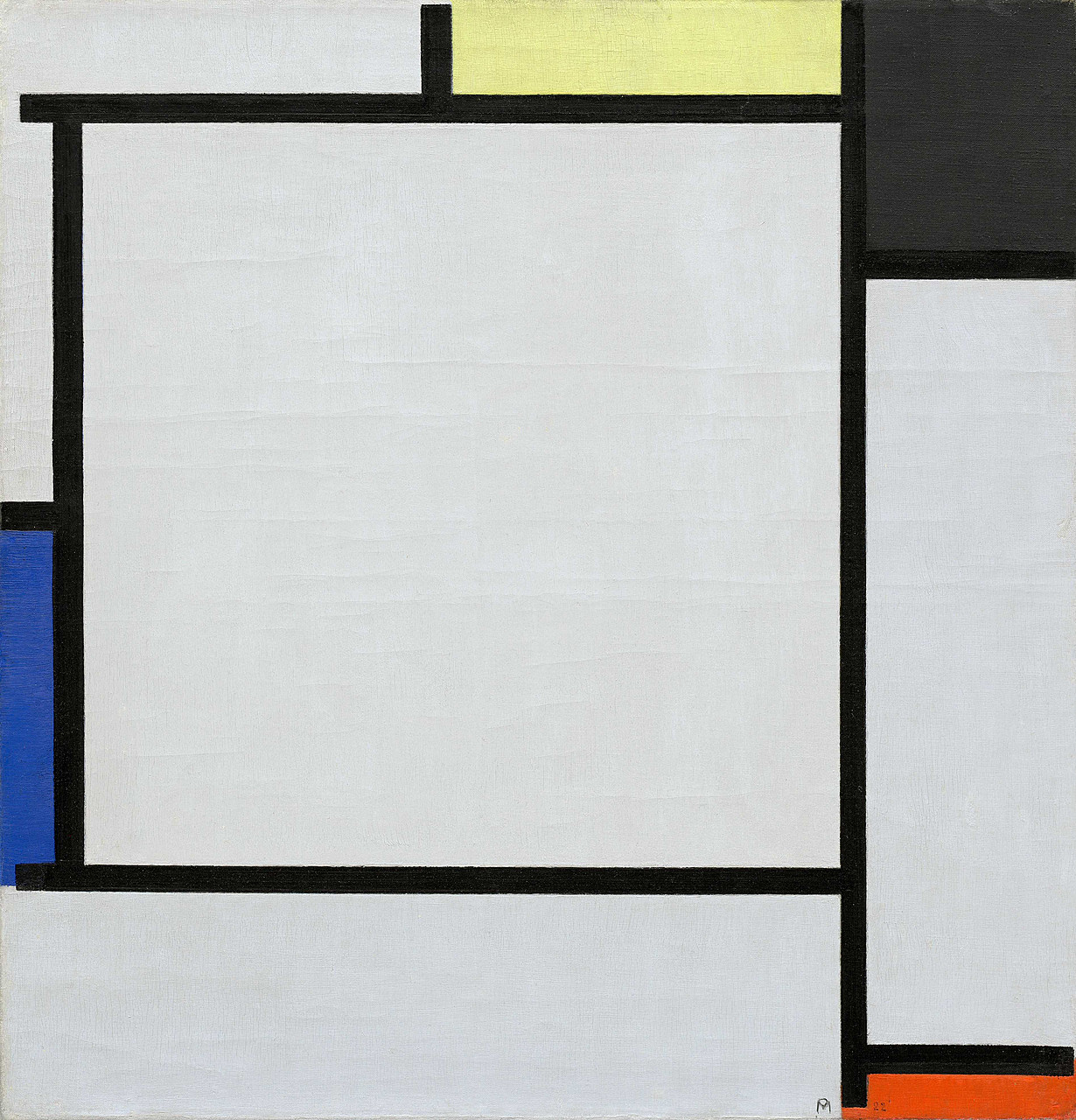
Mondrian's passage toward abstraction

Mondrian early naturalistic work
c.1908 Naturalistic — direct depictions of Dutch landscape and nature
Mondrian Still Life with Gingerpot II
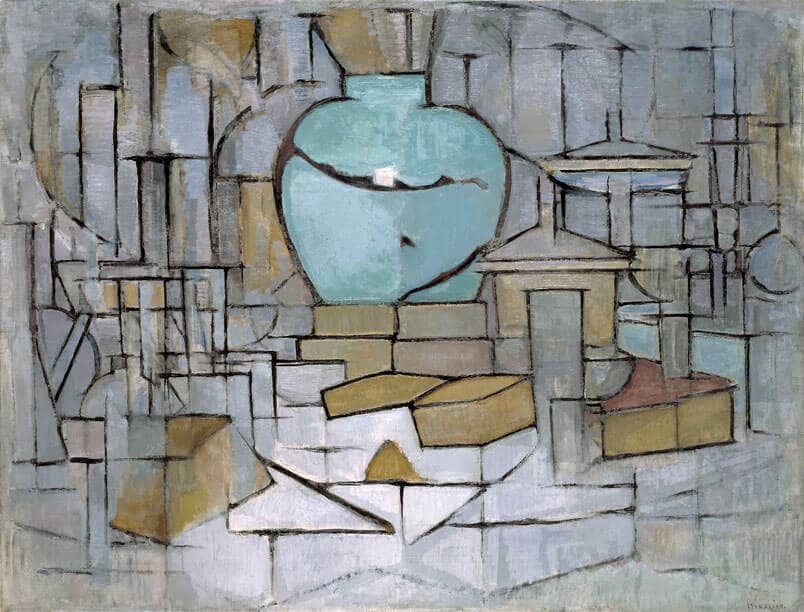
1911–12 Gingerpot II — the natural still life converted into the cubist system of abstraction via a grid framework
Mondrian Tableau No. 2
1913 Tableau No. 2 — although painting a tree, he names it only as composition. The object is lost from the title.
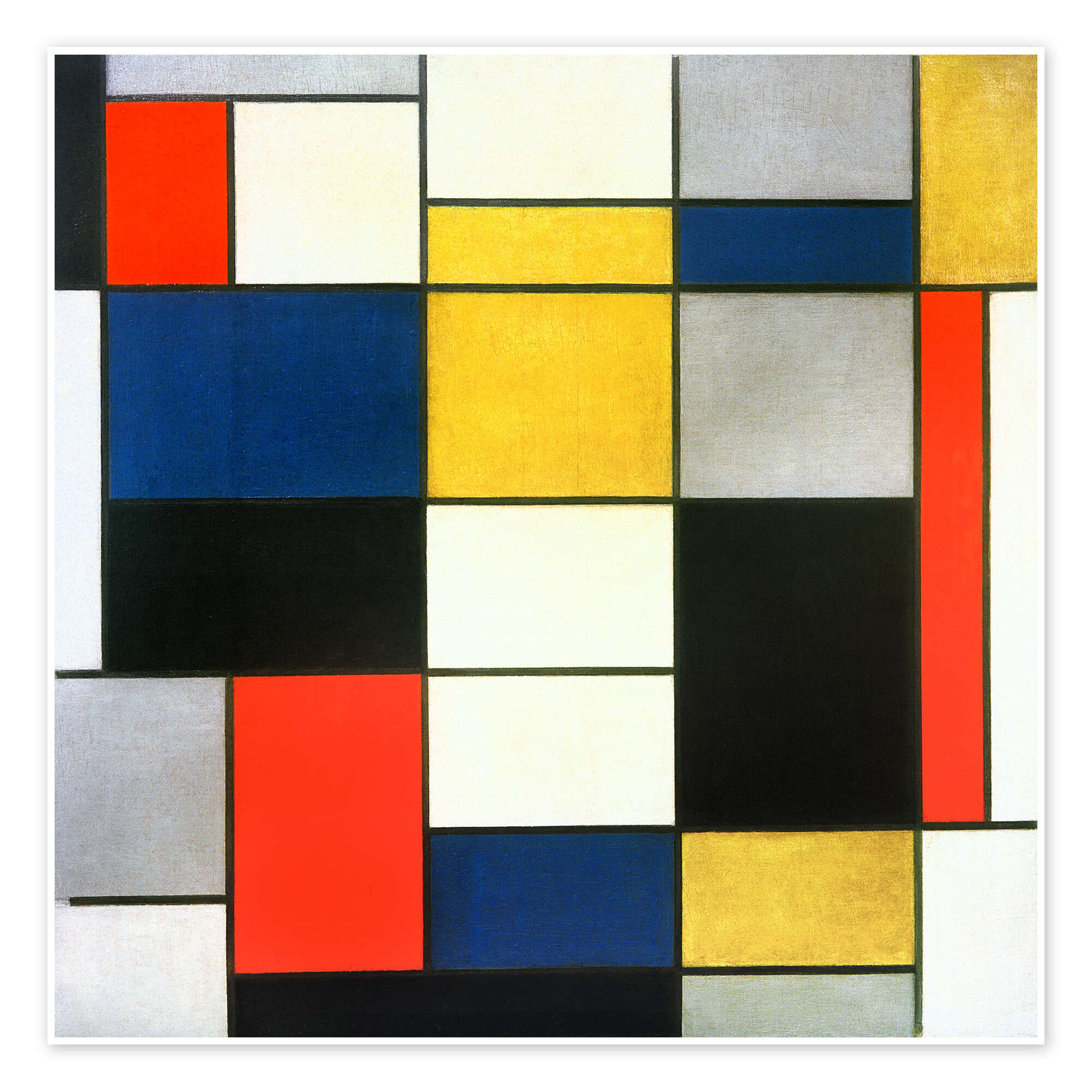
Mondrian Composition A 1920
1920 Composition A — full Neoplasticism. "Art should not concern itself with reproducing images of real objects, but should express only the universal absolutes that underlie reality."
13
Mondrian, Composition A, 1920
Mondrian — Composition A (1920) Oil on canvas, 36 × 36¼ in · Galleria Nazionale d'Arte Moderna, Rome
Mondrian & Kirzner

Equilibrium as Art

Instead of seeing Mondrian as the height of abstraction — and that abstraction is vice — we should focus on his treatment of equilibrium. "Naturalistic painting can make us feel the harmony that transcends the tragic, but it cannot express it determinately, since it does not express equilibriated relationships exclusively." (Natural Reality and Abstract Reality, p.30)

Mondrian's contempt for nature is famous. It is claimed he'd sit with his back to a window so that he wouldn't see the green landscape. But Mondrian's movement from nature to abstraction was underpinned by the desire for accurate representation: "The more the natural is abstracted, the more pronounced is the expression of relationship."

Similarly Kirzner rescues the subject matter of economics true to Robbins — the human actor — within the context of neoclassical thought. He utilised an abstract notion of equilibrium to chart the pattern of change, and the movement caused by entrepreneurial activity.

Graph showing the demand and supply curve

Demand and supply

Neoplasticism — Mondrian

Harmony Through Opposition

He [Mondrian] viewed the horizontal and vertical as basic oppositional principles that could interact to produce a union symbolizing a state of universal harmony.

Lucy Flint, Guggenheim Museum

Classical Economics — Alfred Marshall, 1890

Equilibrium Through Markets

He [Marshall] viewed the demand and supply as basic oppositional principles that could interact to produce an equilibrium symbolizing a state of market clearance.

Evans, this essay (a utilisation of artistic license)

15
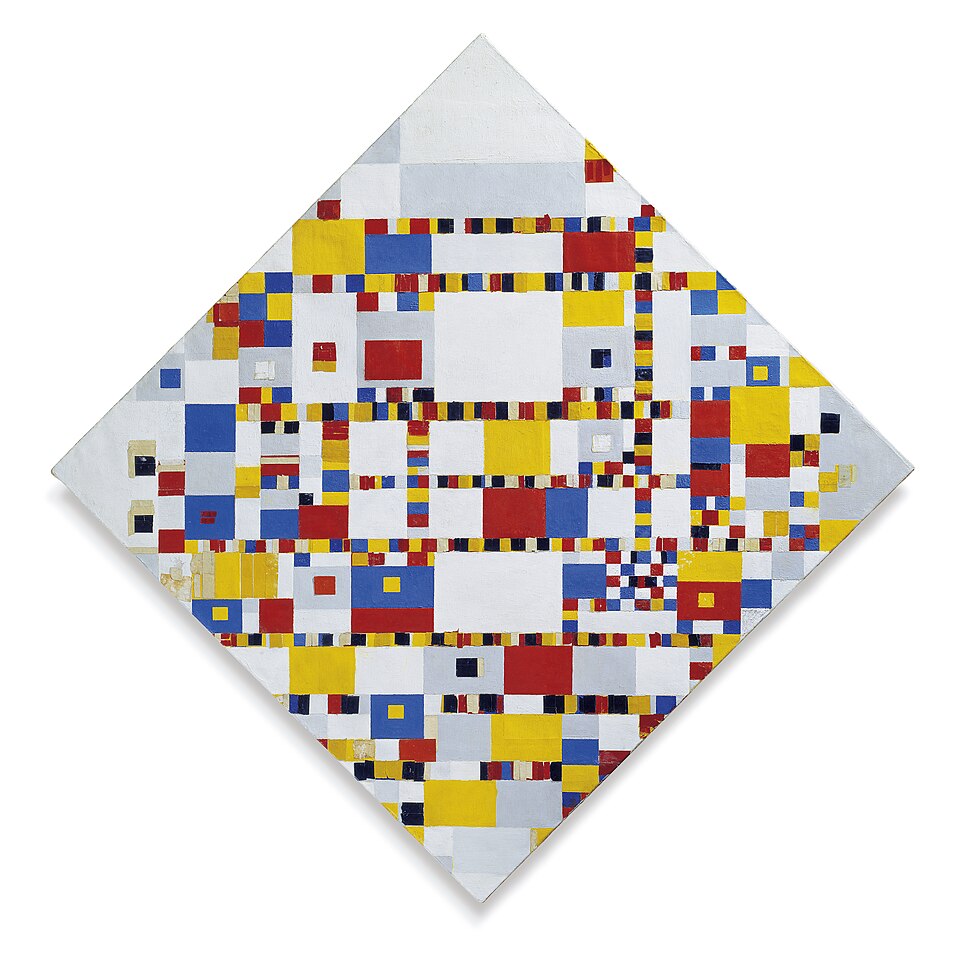
Mondrian, Victory Boogie Woogie
Mondrian — Victory Boogie Woogie (1942–44, unfinished) His final work, painted in New York. Carl Bovill translated each colour into a numerical equivalent and graphed the result: a fractal rhythm, bouncing between order and surprise.
The Late Mondrian

Order, Spontaneity, and the New Life

In 1940 Mondrian moved to New York and once more his paintings responded to the influence of his time. None more so than the fusion of the road grid system and Boogie Woogie that manifested itself in his last great works. The vibrancy of the colours complements a return to the sprawling, infinite subject matter.

Mondrian felt that it was naïve to think accident and mannerisms were the only means to invoke spontaneity into artwork. "The Mondrian I knew was… spontaneous… an eternal optimist with undiminished interest in the dynamics of change." Sigried Giedion saw De Stijl as avant-garde individualists.

His abandonment of the golden ratio runs as counter to the artistic intellectual elite as Kirzner's reintroduction of human action to neoclassical analysis. Indeed the dependency of the two is apparent in the dedication of a neoplastic pamphlet: AUX HOMMES FUTURS (the men of the future).

Capitalism, then, is by nature a form or method of economic change and not only never is but never can be stationary… It must be seen in its role in the perennial gale of creative destruction. — Joseph Schumpeter, Capitalism, Socialism and Democracy, 1942

08
Boccioni, The City Rises
Boccioni — The City Rises (1910) Oil on canvas · Museum of Modern Art, New York
Boccioni & Schumpeter

The Gale of Creative Destruction

In The City Rises we see an immense equine perfectly encapsulate the power of progress to both enthral and scare. In the top right of the picture scaffolding suggests building and construction, and below that the might of man struggles against the inevitable force of the beast.

Schumpeter's writing is every bit as industrial and destabilising as Boccioni's painting and sculpture. In contrast to Kirzner and Mondrian's attempts to move from disorder to order, and capture the complexity of society within the constraint of abstraction, he mirrored the futurist's vengeance for progress.

Such change, and having to overcome resistance to it, was the biggest problem faced by Schumpeter's view of entrepreneurship. For a complete theory of the entrepreneur, we must treat Schumpeter and Kirzner as two sides of the same coin.

Room III

Conclusion & Future Paths

Gary Becker is a Urinal

In the first essay we looked at the cubist engulfment of futurism, and how cubism was a crucial stream toward a delta of geometric abstraction. This was likened to the role of positivism in modern economic theory, and how it paved the way for the neoclassical synthesis. Perhaps the classic embodiment of geometric abstraction is neoplasticism, and by focusing on the equilibriating process of Mondrian a similarity was drawn to Israel Kirzner — portrayed alongside Joseph Schumpeter in the context of their different concepts of the entrepreneur.

Lucien Freud · Herbert Simon

The Human Form

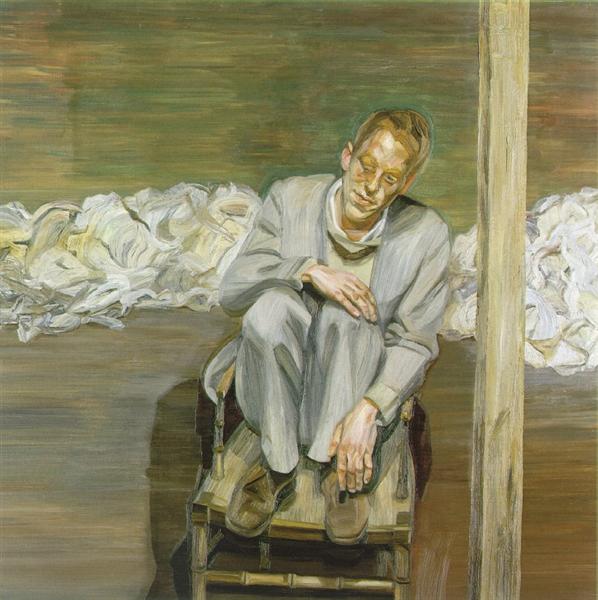
Lucien Freud has acted as a crucial counterbalance to modern conceptual art, retaining the presence of flesh and body — portraiture — in his works. This might be compared to the economics of Herbert Simon, and how his emphasis on bounded rationality introduced human cognition to the maximising agent. Importantly, both men enjoyed successful careers at the pinnacles of their profession.

Oil painting by Lucien Freud of a red haired man sitting in a chair

Red Haired Man on a Chair - Lucian Freud - 1962

David Hockney · Deirdre McCloskey

Hidden Rhetoric

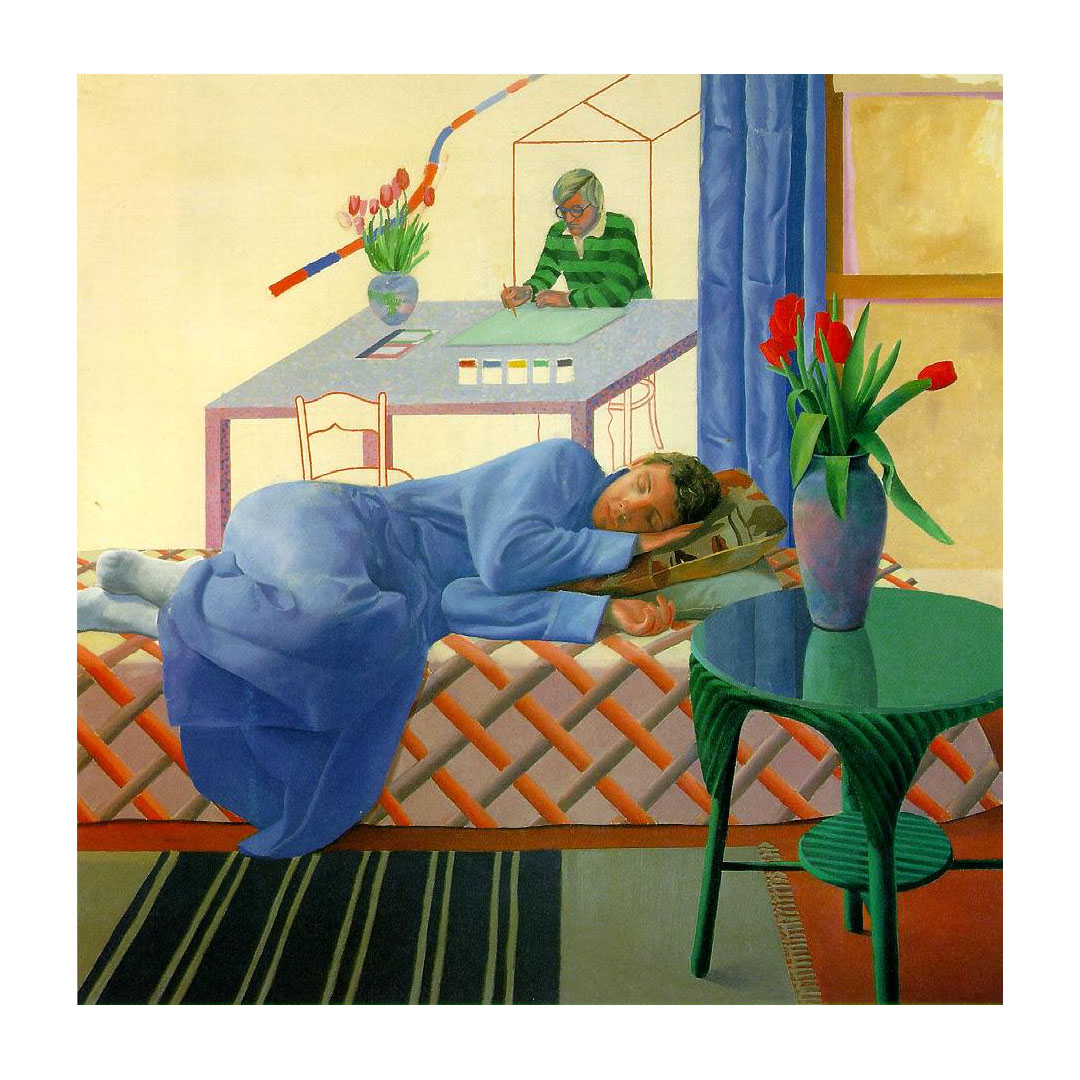
David Hockney has written about how a painter's technique reveals more than is their intention, and mocks this by literally depicting himself within some of his works. This might be compared to the work of Diedre McCloskey, and how she uncovers the hidden rhetoric in economic discourse, and masked bias in econometric studies.

Oil painting by David Hockney of a person lying asleep on a bed wearing a blue housecoat in the foreground and the artist in the background, painting at his desk.

Model with Unfinished Self Portrait - David Hockney - 1977

Marcel Duchamp · Gary Becker

The Expanding Margin

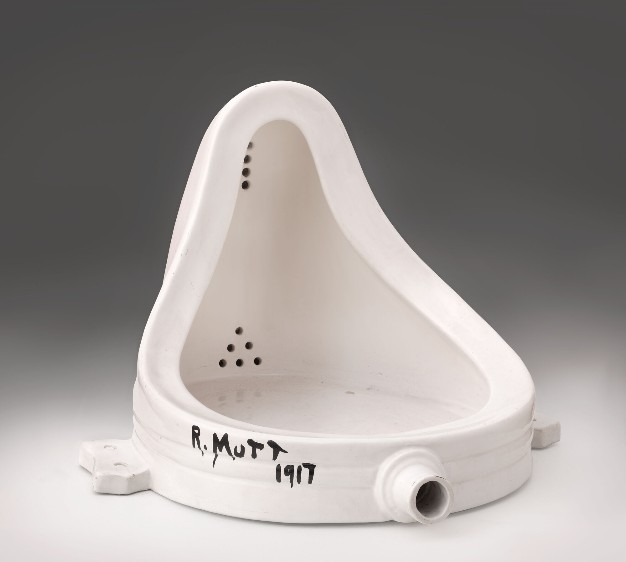
Duchamp's conceptual art — for example a simple urinal — is "the life in art." The way he brought real life into the galleries can be compared to how Gary Becker brought economics into life — "the economics of life." In each case the consequence of imaginative and visionary radicalism is a degeneration of where the margins of the discipline lie.

Art installation by Marcel Duchamp of a urinal.

Fountain - Marcel Duchamp - 1917

Within this speculative and primitive essay it is hoped that two things have been achieved: the alignment of artistic endeavour to economic theories of entrepreneurship (i.e. the artist as entrepreneur), and also that meaningful analysis can be made by bridging economic methodology and artistic theory. There is plenty more still to be done. — Anthony J. Evans, April 2005

Credits: The inspiration for this article came from Peter J. Boettke. The work of Arjo Klamer provided important foundations.